

CLIL (Content and Language Integrated Learning)
Who is this course designed for?
- Teachers and classroom assistants who teach subjects through English (i.e. History, Geography etc.) to primary or secondary students.
- Teachers who currently teach a subject other than English in their native language but who are interested in integrating English into their lessons.
- English as an Additional Language (EAL) teachers who work with non-native speaker teachers in mainstream classes.
- Teaching professionals interested in exploring the key principles of CLIL.
Entry requirements
This course is suitable for teaching professionals with a B1+ or higher level of English.
Course objectives
This course aims to train teachers in the methodology of CLIL (Content and Language Integrated Learning). It combines a focus on developing an understanding of the key principles and terminology of CLIL with an emphasis on exploring practical ideas to help better integrate the teaching of language and content in the classroom. The group input sessions follow a loop input structure so course participants can experience a wide sample of activities that they can take with them to their own teaching context.
After taking the course, you should expect to:
- Improve your command of your English for classroom management
- Increase your awareness of the current trends in CLIL (Content and Language Integrated Learning)
- Have a greater repertoire of activities to integrate English into your teaching context
- Increase your cultural awareness
The two and four week courses also include the opportunity to take the Cambridge Teaching Knowledge Test (TKT) CLIL module.
Course content
- Aims and Rationale of CLIL
- Language Demands of Subject, Content and Task
- Classroom Language
- Communication Skills across the Curriculum
- Resources and Visuals
- Scaffolding Content and Language Learning Activities
- Types of Assessment and Assessment Support Strategies
- Learning Strategies
Your time commitment
This is a full-time course, with 5 hours of sessions each day, and homework to complete in the evenings.
Assessment and Certification
If you choose to take the exam, this is a 1 hour 20 minute TKT exam. You will recieve a TKT Certificate.
On all courses, you will receive an IH Newcastle certificate on successful completion.
About the school
Apollo IH Hanoi is part of a large group of language schools concentrated in Hanoi and Ho Chi Minh City. Each branch has a very modern feel, and its styled with an eye for detail.
If you are at school at class drop off time, watch out for all the parents dropping off their kids as passengers on their mopeds! With great safety and order, hundreds of excited kids rush into the school!
Situated a 10-minute drive from the hustle and bustle of Hanoi’s famous Old Quarter (home of Hoan Kiem lake), our Pho Hue centre is situated in the Hai Ba Trung area of Hanoi. This is where teacher training happens.
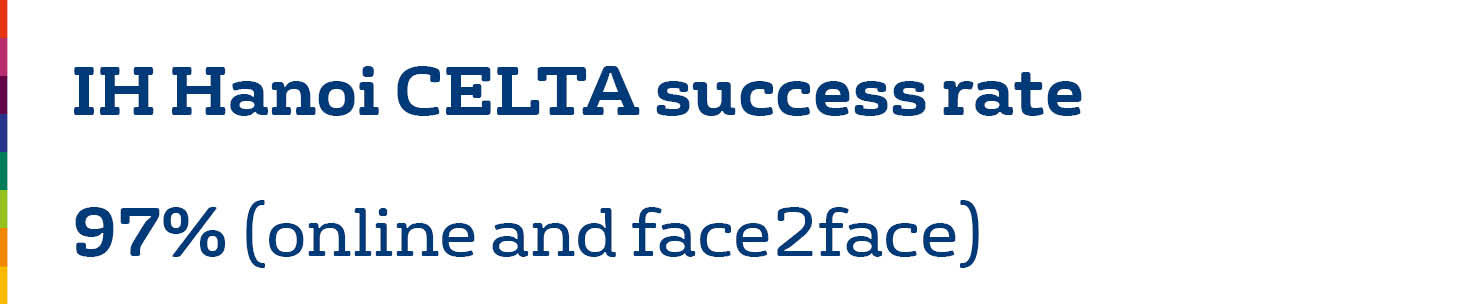
Ha Noi (sometimes Hanoi) is iconic due to its status as the country’s capital city, but the story only really begins there. Whilst developing at a speedy pace, it still maintains its charming characteristics that make it such a popular place to live. The city is the second largest city in Vietnam, with around 3.5 million residents, and is located in the north of the country.
There is no shortage of adventures on offer. There are many famous buildings to visit in and around Hanoi such as the Temple of Literature, Perfume Pagoda and the Ho Chi Minh Mausoleum. The cafés and small streets provide a gentle mix of its French heritage and show signs of other former rulers. The lakes and parks across town also add to the attraction of living in the city.
Hanoi has an international airport which is served by a variety of routes and carriers. Those coming from further afield may well have to stop off in larger hubs such as Dubai or Bangkok on their way here. The airport has shuttle buses into town, although taxis from the airport are affordable (between 10-20USD).There is parking in the basement of our school – but for motorbikes only!
Transport is relatively cheap, with improving bus services in the cities. The Grab app is the most common way to get a taxi or motorbike taxi. (It’s like Uber with a motorbike!) You can rent a motorbike for a round 40-50 USD for the month if you prefer!
There are almost limitless options to explore Vietnamese coffee and street food within five minutes’ walk of the school. If you don’t wish to venture out in the heat of the day, it’s easy and cheap to get a wide variety of cuisines delivered to the school.
If you eat like a local, you can have delicious food from local eateries for less than 2USD per meal. If you prefer home comforts, you could be spending 10USD per meal excluding drinks.
Accommodation
We don’t provide any formal support but are happy to offer advice on finding somewhere to stay. It’s very easy to find cheap and comfortable short or long-term accommodation in Hanoi. Visit Airbnb or Booking.com to get an idea of prices. There are plenty of very active housing groups on Facebook that you could join, especially if you wish to find a room in a shared house or flat, as people regularly post there. We recommend that you find somewhere close to the school during the course, as traffic can move slowly during rush hour. It’s perhaps better to find something temporary over the course and then find something for the longer-term once you know where in the city you will be working.
Cost of living is famously very reasonable in Vietnam, although it’s possible to also spend a lot depending how you choose to live. A room in a shared house will cost around 200-250 USD per month, a studio flat 300-450 USD.